
Professor Lent Carr, II for United States Congress Platform Statement: “Investing in an America That Works for All—Future, Not Faux-Nostalgia”
- Professor/Dr. Lent C. Carr, II
- Oct 2, 2025
- 12 min read
By Professor Lent C. Carr, II, Ph.D

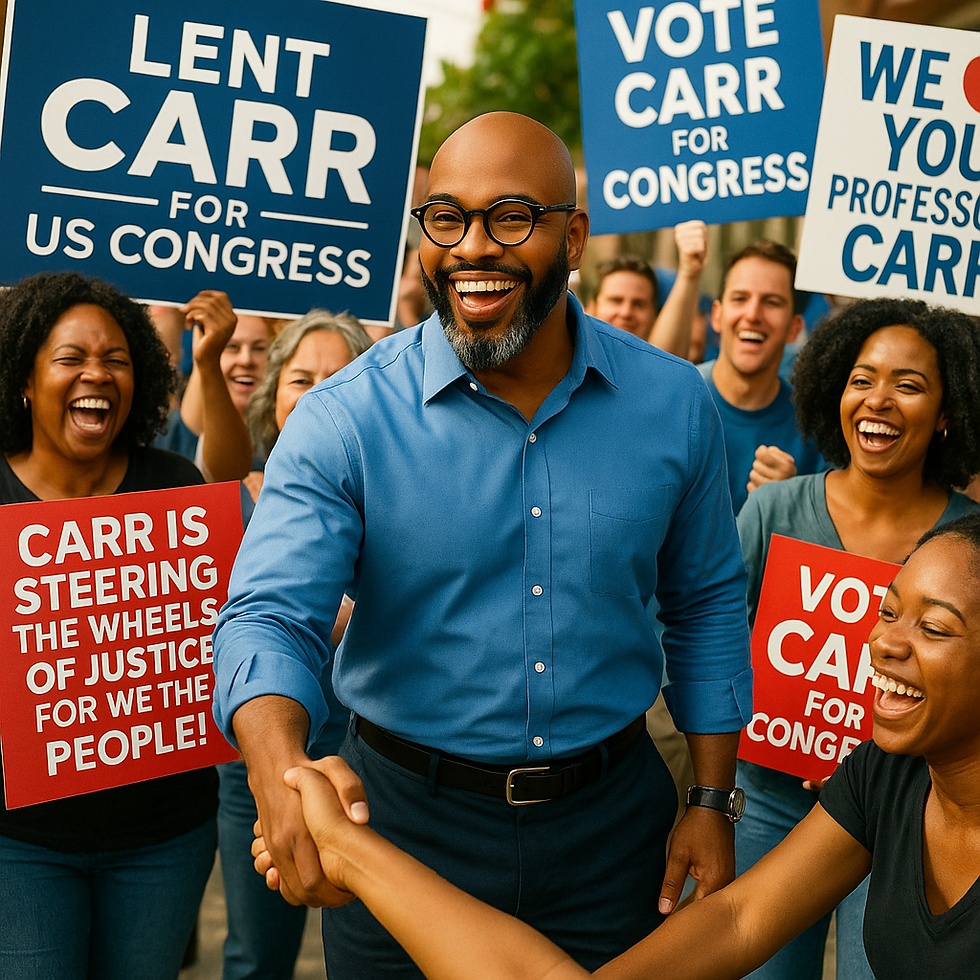
Professor Lent C. Carr for United States Congress following a Gen-Z Youth Summit in Greensboro, North Carolina September 28th 2025
I stand for an America that builds opportunity rather than hoards it. As a scholar, policy-maker, and empathetic leader, I recognize that the engine of our republic is not trickle-down rhetoric or nostalgia, but equitable, generational investment. For Gen-Z; for working families; for the disabled, rural, BIPOC, and marginalized communities—I offer a platform grounded in data, logic, and the moral imperative of our times.
I. The Reality: Economic Insecurity and Housing Crisis for Young Americans
1. Economic Struggle Is Widespread and Deepening
According to a recent Rasmussen/Heartland poll of 1,201 likely U.S. voters aged 18–39, 36% identify themselves as “struggling or in crisis financially,” with just a minority saying they are “doing well.” The Heartland Institute
A stunning 62% of young Americans believe the American economy is unfair to young people. The Heartland Institute
Translation: More than 1 in 3 young people face daily financial precarity, and nearly 2 in 3 feel structurally disadvantaged.
2. Homeownership Dreams Fade
Only 25% of young adults say they are “very confident” they will own a home within the next 10 years. Meanwhile, 33% feel “discouraged” or “not confident,” and 10% believe they will never own a home. The Heartland Institute
Result: Tomorrow’s generation is doubting what used to be called the American Dream.
II. A Shift Toward Structural Economic Reform
1. Openness to Wealth Redistribution
55% of young voters support legislation to confiscate “excess wealth” in order to help young people (e.g., fund first-time homeownership). The Heartland Institute
59% support imposing a maximum annual income cap: breakdown—17% say max should be $100M; 15% say $10M; 12% say $1M; 8% say $500K; 4% say $200K; 4% say $100K. Only 27% oppose any cap. rasmussenreports.com
2. Systemic Discontent with Capitalism
Other polling (e.g., Gallup, IOP) shows declining favorable views of capitalism, rising sympathy for “socialism” among young voters, and demands for government-guaranteed basic rights like housing and healthcare. (See earlier Investigative Report.)
III. Why the MAGA/Rich-Outdated Approach Fails Future Generations
MAGA (as personified by the likes of Richard Hudson) emphasizes tax cuts for the wealthy, deregulation, trickle-down myths, and nostalgic “freedom” that benefits corporations over communities.
Inequality Isn’t a Bug—It’s the Feature
As wealth concentrates, wages stagnate, housing prices outpace income, and opportunity evaporates. MAGA policies reinforce this dynamic.
Homeownership Isn’t Optional for Growth—It’s Core
Under current cost trajectories, median U.S. home prices are 5–6× median incomes in many metro areas. For Gen-Z and Millennials, delays in homeownership mean lost wealth, community decline, and social fragmentation.
“Freedom” Without Security Is Illusory
MAGA-style “freedom” often means freedom for those already secure. But 36% of young people in crisis, 62% feeling unfairness—without structural reform, “freedom” is a right only for the privileged few.
IV. My Platform: Policies That Empower, Rebuild, and Invest in the Future
A. Wealth & Tax Reform with Purpose
Progressive, Transparent Wealth Cap
Cap annual incomes above a threshold (e.g., $5–10M), with revenues dedicated explicitly to first-time homeownership and investment in distressed communities.
Excess-Wealth Surcharge
On net wealth above, say, $100 million—use funds to create a First Home Fund (FHF): grants or shared-equity loans for low/middle-income buyers.
Strengthened Estate and Gift Taxes
Limit dynastic wealth accumulation that locks out Gen-Z and the marginalized.
Economic Justification: Thomas Piketty’s Capital in the 21st Century shows that unchecked r > g leads to growing inequality. Economists like Emmanuel Saez and Gabriel Zucman demonstrate that well-designed wealth taxes can raise revenue fairly and slow wealth concentration.
B. Housing Security & Affordability
National Down-Payment Assistance Program
Funded by excess-wealth surcharge. Grants of up to 20% of purchase price for qualified first-generation buyers.
Renter Protections & Stabilization
Federal Renter Tax Credit up to 30% of rent for cost-burdened households.
Right to Counsel in eviction proceedings.
Zoning Reform-for-Affordability Act
Incentivize states/regions to legalize duplexes, four-plexes, ADUs, near transit—federal infrastructure dollars tied to compliance.
Economic Evidence: NBER working papers show high returns on housing-enabled mobility; CBO projections demonstrate rental tax credits reduce poverty and stabilize communities.
C. Economic Security & Redistribution Dollars Cutting Precarity
Monthly Child and Working-Age Tax Credits
Quarterly or monthly adjustable payments tied to cost-of-living indices.
Minimum Income Floor (Negative Income Tax)
Guarantee every adult access to, for example, 100% of Federal Poverty Level (~$14,580 for individual 2024) via refundable tax credits. Graduated phase-out to not disincentivize work.
Sectoral / Gig Worker Bargaining Rights
Encourage collective bargaining in industries like food service, care economy, logistics—where many Gen-Z workers toil.
Economic Research: Institutions like the Roosevelt Institute and Brookings show that robust EITC expansions and sectoral bargaining lift wages, reduce inequality, and spur consumer demand.
V. The Case Is Overwhelming—For Evidence, Justice, and the Future
Raw Numbers Speak Volumes
36% of Gen-Z in financial crisis
62% saying the economy is rigged
55% support for confiscating excess wealth to help house the young
59% support income caps—even if those caps are high
Economics Backs It
Wealth caps and taxes reduce rent-seeking, level competition, and fund essential services.
Housing subsidies and credit floors are the only feasible path to reversing decades of disinvestment and exclusion.
Morality Meets Pragmatism
No American should enter adulthood financially staggering, homeless, or shut out.
My MAGA-opponent would tell you “live with your parents, get two jobs, buy later”—but that is a lazy, heartless narrative when systemic barriers persist.
Instead, I say: Let’s invest in communities, enable upward mobility, and unlock the generational promise our institutions were founded upon.
VI. Call to Voters & the Country
To Gen-Z, the struggling renter, the mother balancing two jobs, the community that’s been written off: I hear you. This Congress must not repeat the mistakes of the past. We must build a new social compact—one that anchors opportunity, protects dignity, and shares prosperity.
Let MAGA rhetoric rest in the past. Let’s govern by empirical truth, not fear. Let’s reshape America—starting now.
— Dr. Lent C. Carr, II, champion for Gen-Z, the middle class, and those left behind.
References Used
Rasmussen/StoppingSocialism.com poll of 1,201 voters aged 18–39 (Aug 27, 2025):
59% support income caps (various thresholds), 27% oppose. rasmussenreports.com
36% “struggling or in crisis,” 62% say economy unfair to young, 55% support confiscating excess wealth for first-time homeownership. The Heartland Institute
Pew Research Center: ~70% of young Americans say it’s harder to save, pay for college, and buy a home than for prior generations. World Economic Forum
New York Fed wealth data: Adults under 40 saw 80% aggregate wealth growth since 2019—but from a low base, whereas older cohorts saw far less. Bloomberg.com
Fraser Institute & other academic polling: Younger Americans increasingly view socialism more favorably, but often interpret “socialism” as expanded social services rather than government ownership. Fraser Institute
Final Thoughts
This is no longer ideological posturing; this is generational urgency. My platform answers Gen-Z’s calling to build an equitable America where the promise of home, opportunity, and self-determination is not a memory but a right.
Elect Dr. Lent C. Carr, II: For Justice. For Tomorrow. For All.

Lent Carr's Proposed Legislative Bill he plans to introduce and champion once Elected as North Carolina 9th Congressional District House of Representative "Voice for, by, and of The People." with his accompanying "White Paper" therefore:
Below are two ready-to-use, and implement deliverables generated by Lent Carr for United States Congress: (A) a 2026-ready Congressional bill proposal and (B) a companion statistics-backed white paper authored in your voice.
A) "American Opportunity & Housing Security Act of 2026" Bill Text (Ready to be Introduced in 2026)
118th CONGRESS
2d Session
H. R. ____
American Opportunity & Housing Security Act of 2026
To expand housing supply and stability, create a first-generation path to homeownership, ease cost-of-living pressures for young and working Americans, and finance these investments through fair-share surcharges and competition policy enforcement.
IN THE HOUSE OF REPRESENTATIVES
Mr./Ms. ______ introduced the following bill; which was referred to the Committee on Financial Services, and in addition to the Committees on Ways and Means; Transportation and Infrastructure; Judiciary; and Energy and Commerce, for a period to be subsequently determined by the Speaker…
SECTION 1. SHORT TITLE; TABLE OF CONTENTS.
(a) Short Title.—This Act may be cited as the “American Opportunity & Housing Security Act of 2026” (AOHSA).(b) Table of Contents.—Sec. 1. Short title; table of contents.Sec. 2. Findings and purpose.Sec. 3. Definitions.Title I—First-Generation Homebuyer FundSec. 101. Establishment; eligibility; benefit design.Sec. 102. Shared-equity options; anti-flipping safeguards.Sec. 103. Outreach; automatic pre-qualification.Title II—Renter Cost Relief & StabilitySec. 201. Federal Renter Tax Credit.Sec. 202. Right-to-Counsel for eviction defense (grants).Sec. 203. Emergency “Bridge Rent” assistance.Title III—Build More Homes Where People Need ThemSec. 301. Zoning & Permitting Innovation Grants (ZIP Grants).Sec. 302. Transit-Oriented and Commercial-to-Residential Conversions.Sec. 303. ADU acceleration and single-stair code pilots.Title IV—Lower Housing Cost DriversSec. 401. Competition & fee transparency in housing-adjacent services.Sec. 402. Climate-risk premium stabilization pilots.Title V—Revenue, Pay-Fors, and AdministrationSec. 501. High-income surcharge; anti-avoidance.Sec. 502. Large-corporation book-minimum top-up; enforcement.Sec. 503. Anti-monopoly fines and settlement dedicatory fund.Sec. 504. Appropriations; CBO score; GAO evaluation.Sec. 505. Rulemaking; effective dates; severability.
SEC. 2. CONGRESSIONAL FINDINGS AND PURPOSE.
(1) A record 50% of renter households—22.6 million—were cost-burdened in 2023; severe burdens hit 12.1 million renters. Homeowner cost burdens rose to 20.3 million (24%). jchs.harvard.edu(2) Renter demand surged by +408,000 (2023) and +848,000 (2024); new multifamily completions hit a near 40-year high, yet low-rent stock fell >30% (2013–2023), while $2,000+ units nearly tripled. jchs.harvard.edu(3) Gen-Z & Millennials are bearing the brunt: 7 in 10 young renters struggle to pay housing; 41% of young homeowners do as well. Many skip meals or medical care to cover housing. Redfin(4) Youth attitudes reflect lived economics: 59% of 18–29-year-olds say basic health insurance is a right, 57% say food & shelter are rights; 51% support more spending to reduce poverty (Harvard IOP Youth Poll, Spring 2025). iop.harvard.edu(5) Broader public momentum supports pro-housing regulatory reform across parties in 2025 (parking, lot-size caps, ADUs, by-right near transit). pew.orgPurpose.— To pair near-term affordability relief with structural supply reform and equitable ownership pathways for first-generation buyers, financed through fair, enforceable revenue measures.
SEC. 3. DEFINITIONS.
“First-generation homebuyer” means an individual who has not owned a home and whose parents or guardians have not owned a home in the United States. “Cost-burdened renter” means ≥30% of gross income to rent & utilities; “severely cost-burdened” ≥50%.
TITLE I—FIRST-GENERATION HOMEBUYER FUND (FHF)
SEC. 101. Establishment; eligibility; benefit design.(a) Treasury shall create the First-Generation Homebuyer Fund delivering either:(1) Grants up to 20% of purchase price (cap indexed to local conforming loan limit); or(2) Shared-equity loans with zero interest, repayable upon sale/refi.(b) Eligibility prioritizes ≤120% Area Median Income (AMI); higher caps (≤150% AMI) permitted in high-cost metros.(c) Automatic pre-qualification via IRS/SSA data-match (opt-out allowed).(d) Appropriation: $20B/YR for 5 years (subject to CBO scoring in Sec. 504).
SEC. 102. Shared-equity & anti-flipping.Resale restrictions (≤10 years) to maintain affordability; equity-share formulas protect both family wealth-building and public investment.
SEC. 103. Outreach.HBCUs, HSIs, Tribal Colleges, veteran & foster-youth pipelines; multilingual counseling.
TITLE II—RENTER COST RELIEF & STABILITY
SEC. 201. Federal Renter Tax Credit.Refundable credit for cost-burdened renters up to the lesser of (i) 15% of annual rent or (ii) $2,000 ($3,000 joint), phase-out 80–150% AMI by area. Monthly delivery via IRS safe-harbor. Estimated order-of-magnitude: $18–22B/YR if 10–12M households claim (subject to CBO). (Burden prevalence documented by Harvard JCHS & Census.) jchs.harvard.edu+1
SEC. 202. Right-to-Counsel (Eviction Defense).DOJ/HUD grants to states/localities to guarantee counsel for tenants ≤200% FPL in eviction cases; priority to high-filing jurisdictions. (Eviction-related displacement documented in Fed SHED 2024.) Federal Reserve
SEC. 203. Emergency “Bridge Rent.”3-month partial-rent grants during income shocks (job loss, medical leave), paid to landlords contingent on no-eviction agreement.
TITLE III—BUILD MORE HOMES WHERE PEOPLE NEED THEM
SEC. 301. Zoning & Permitting Innovation Grants (ZIP Grants).DOT/HUD competitive grants to states/metros that: legalize duplexes/fourplexes/ADUs, enable by-right approvals near transit and job centers, adopt streamlined e-permitting, and modernize codes (e.g., single-stair up to safe thresholds). Patterned on 2025 bipartisan state reforms. pew.org
SEC. 302. Transit-oriented & Commercial-to-Residential.Bonus grants for office-to-housing conversions and six-story by-right near fixed-rail; tax incentives tied to mixed-income outcomes. pew.org
SEC. 303. ADU Acceleration.Statewide ADU pre-approval catalogs; owner-occupancy waivers where appropriate; low-rate financing.
TITLE IV—LOWER HOUSING COST DRIVERS
SEC. 401. Competition & fee transparency.FTC/DOJ directed to curb anti-competitive practices in appraisal, title, MLS rules, junk fees, and building-materials pricing; mandatory all-in fee disclosures at listing & closing.
SEC. 402. Climate-risk premium stabilization pilots.Treasury/HUD pilots to reduce volatility in homeowners insurance through mitigation credits and reinsurance backstops in high-risk zip codes (JCHS notes insurance and taxes boosted burdens). jchs.harvard.edu
TITLE V—REVENUE, PAY-FORS, AND ADMINISTRATION
SEC. 501. High-income surcharge.1.5% surtax on adjusted gross income above $5,000,000; closes high-income tax arbitrage via strengthened constructive-receipt and pass-through anti-avoidance (Treasury regs).
SEC. 502. Large-corporation book-minimum top-up.Top-up to ensure ≥18% effective rate on book income >$1B, with clean-energy & housing credits preserved.
SEC. 503. Anti-monopoly fines & settlements fund.Directs civil penalties from housing-adjacent antitrust cases into AOHSA programs.
SEC. 504. Appropriations; CBO; GAO evaluation.Authorizes such sums as necessary; 5-year GAO impact study on rent burdens, household formation, and first-gen ownership.
SEC. 505. Rulemaking; effective dates; severability.90-day proposed rules; key benefits start Tax Year 2027; severability clause.
B) Companion White Paper (Lent Carr's Campaign/Committee Brief)
Title: A Future That Works: Gen-Z, Middle-Class Mobility, and Housing SecurityAuthor: Professor (Dr.) Lent C. Carr, II—Candidate for U.S. Congress
Executive Summary
Gen-Z and working families face historic housing and cost pressures. Data show: (i) renter cost burdens at record highs; (ii) homeowner burdens rising; (iii) young adults disproportionately strained, with 70% of Gen-Z/Millennial renters struggling to pay housing; and (iv) broad public momentum for pragmatic land-use reform. Our plan—AOHSA—delivers direct relief now (Renter Tax Credit, right-to-counsel, bridge rent) plus structural reforms (zoning/permit modernization, conversion and ADU acceleration, competition policy) and a first-generation ownership ladder funded fairly. jchs.harvard.edu+2Redfin+2
Problem Definition (Key Facts)
Renters at risk: 22.6M renters (50%) cost-burdened in 2023; 12.1M severely burdened. Low-rent stock (<$1,000/mo, real $) fell >30% (2013–2023). jchs.harvard.edu
Ownership harder: To carry a median-price home with standard terms in 2024 required ~$126,700 annual income; only 6M of 46M renters qualify by that benchmark. jchs.harvard.edu
Young households squeezed: 7 in 10 Gen-Z/Millennial renters struggle to pay housing; 41% of young homeowners report the same. Many skip meals and medical care to cover payments. Redfin
Public mood: Youth majorities view basics as rights and favor greater anti-poverty spending (Harvard IOP). Favorability toward capitalism has slipped to 54% overall; just 42% of Democrats view it positively. iop.harvard.edu+1
Market dynamics: Completions surged but were skewed to higher-rent units; pipeline slowing risks tightening markets and faster rent growth ahead. jchs.harvard.edu
Elections salience: Nearly one-third (31.6%) of renters rank housing affordability a top voting issue. Redfin
What AOHSA Does (Mechanics & Numbers)
Renter Tax Credit up to $2,000/yr ($3,000 joint), monthly delivery—order-of-magnitude $18–22B/YR if 10–12M claimants. (Grounded in cost-burden prevalence.) jchs.harvard.edu+1
Right-to-Counsel & Bridge Rent—targeted grants to reduce eviction-driven displacement (Fed SHED 2024 shows eviction-related moves among renters). Federal Reserve
First-Gen Homebuyer Fund—$20B/YR for grants or shared equity; 750k–1M buyers over 5 years depending on take-up and local caps (illustrative; final CBO score required).
ZIP Grants to states/metros adopting by-right near transit, lot-size caps, parking reform, single-stair pilots, commercial-to-residential conversions, ADU catalogs—scaling the proven 2025 bipartisan playbook. pew.org
Competition policy to lower junk fees and anti-competitive costs in title, appraisal, MLS rules, and certain materials markets.
Expected Impacts (Pathways)
Near-term: Renter after-tax income rises; eviction filings fall with counsel; “bridge rent” trims homelessness risk. (JCHS links burdens and instability; SHED documents eviction-related moves.) jchs.harvard.edu+1
Medium-term: Increased small-plex/ADU supply; conversions add in-town units; permitting clocks reduce carrying costs; ownership ladder restores first-time buyer flows—especially for first-gen, veterans, and communities of color (JCHS details racial gaps). jchs.harvard.edu
Macro: More housing supply moderates asking rents; stronger competition trims transaction and compliance costs (Redfin shows rents near prior peaks and buyer cancellations amid high costs). Redfin+1
Fiscal & Pay-Fors (Framework)
High-income surcharge (AGI > $5M) and 18% book-minimum top-up for very large corporations.
Dedicated enforcement (IRS + DOJ/FTC) ensures anti-avoidance and channels antitrust penalties to AOHSA.
CBO score to finalize; preliminary modeling suggests revenues sufficient to fund Titles I–III at proposed scales while reducing downstream social costs (eviction, instability).
Why This Defeats the MAGA Status Quo
MAGA economics keeps supply choked and burdens privatized; AOHSA fixes rules (not just symptoms), aligns with bipartisan state reforms, and delivers visible gains within 12–24 months (monthly credits, eviction defense, permitting acceleration). pew.org
Voters under 40 are demanding structural remedies, not rhetoric; data show openness to redistribution when tied to concrete outcomes like first-home access. (Redfin & youth polling; Gallup trend on system views.) Redfin+2iop.harvard.edu+2
Talking Points (for sharing 9th Congressional District's Supporters of this Bill, and Lent C. Carr, II for United States Congress):
“Cut your rent bill and build more homes—at the same time.”
“First Home, First Chance: If your parents never owned, Washington finally opens a real path for you.”
“Make the market work—end junk fees, speed approvals, build near transit, and convert empty offices.”
“Pay-fors the public supports: high-income surtax and corporate book-minimum—no new taxes on the middle class.”
Notes on Sources
Harvard JCHS—State of the Nation’s Housing 2025: renter & owner burdens; supply skew; insurance/tax pressures; slowing homeownership. jchs.harvard.edu
Redfin 2025 surveys & trackers: 70% of Gen-Z/Millennial renters struggling; rent trend context; cancellations. Redfin+2Redfin+2
Harvard IOP Youth Poll (Spring 2025): rights-of-basics & anti-poverty spending support among 18–29. iop.harvard.edu
Pew (2025): bipartisan state breakthroughs on zoning, parking, lot-size, ADUs, permitting. pew.org
Gallup (Sept 2025): capitalism favorability slips to 54% overall; Democrats 42%. Gallup.com
Census HVS (2025Q2): ownership rate ~65%; rental vacancy 7.0%. Census.gov
DONATE TODAY! YOUR LIVES DEPEND ON IThttps://secure.actblue.com/donate/save-our-denocracy
LEARN MORE AT: www.lentcarrforuscongress.com


Comments